Wednesday, November 27, 2013

Shark Attacks - Who Should Be Afraid?

These are some of my favorite shark graphics.
Appreciate and LEARN. 
Click on the images to make them larger.


Monday, November 25, 2013

Shark Reproduction

We talked about the history of sharks, common characteristics of cartilaginous fish and then the reproductive strategies of sharks.

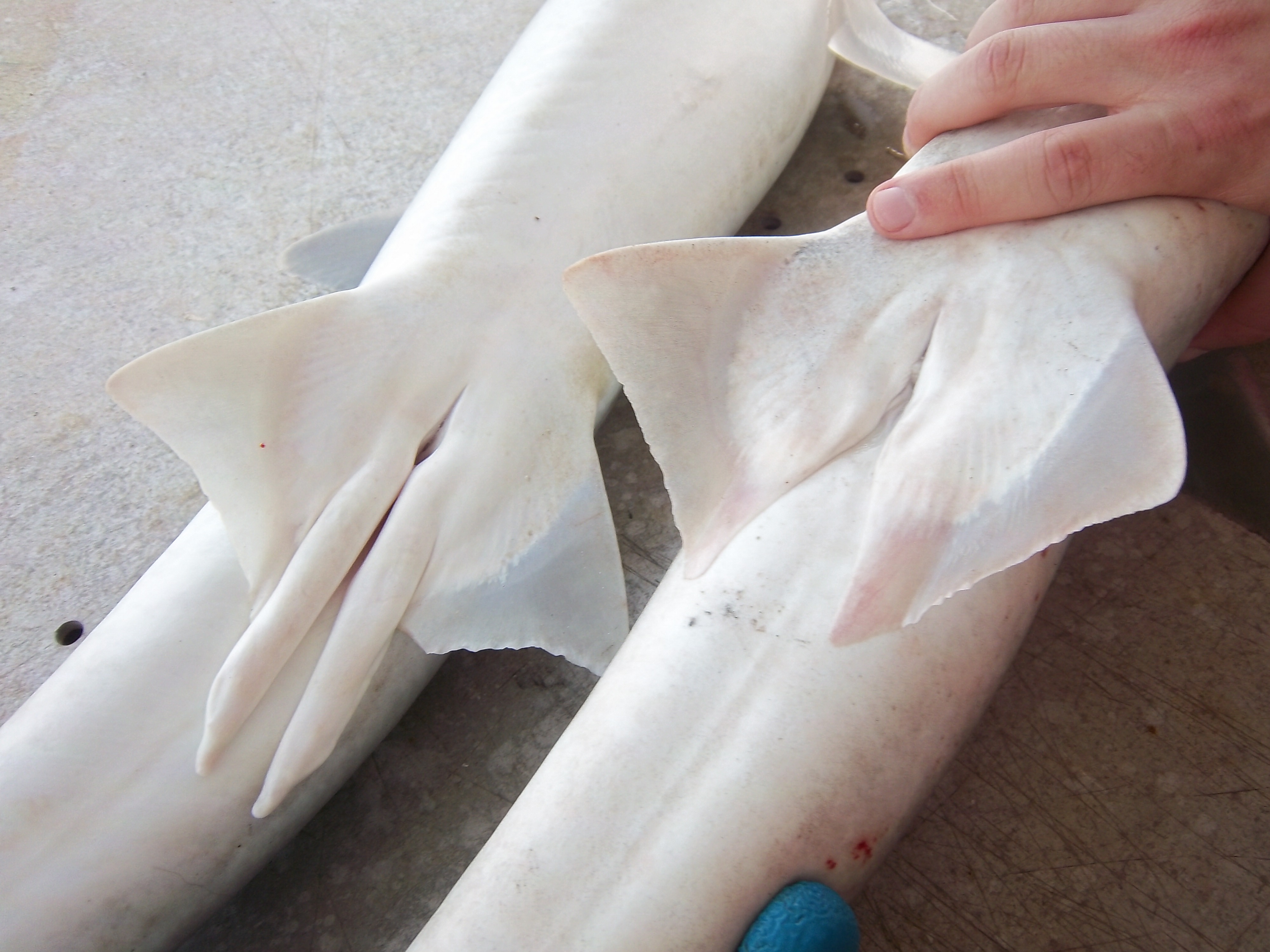
Not a lot is known about shark reproduction because in many cases it has never been observed. Sharks have internal fertilization and the male shark has two claspers for sperm delivery. These can be seen on male sharks protruding from the pelvic fin.

Shark reproduction is violent with males biting the female. As a result female shark skin is much thicker than the males so that this practice does not ham or kill her. She fights a little to ensure that only strong males with good genes are able to fertilize her eggs.

Some sharks are oviparous and lay eggs (pictured). These egg cases are known as mermaid's purses. You can see the baby shark and its nutrient-rich yolk through the leathery egg case.

Some sharks are viviparous and have live birth a lot like mammals.

And some sharks are ovoviviparous and keep their eggs inside the uterus before releasing them... so its making eggs and then kind of having live birth.

Think you know it all? Try "Romancing the Shark," a quiz from Shark Week.

Shark Senses

Today second period learned about shark senses. Sharks have a large brain to help process the sensory overload they must get from the SEVEN senses they have. They have the five we have plus a lateral line (pressure and vibrations) and the ampullae of lorenzini (electro-reception).

Follow this link for a cool interactive about how shark jaws stick out when they attack their prey! The interactive is down at the bottom.

If you are doing a final project on a shark... check out this new link! www.shark.ch

Wednesday, November 20, 2013

Sexual Dimorphism

Sexual Dimorphism is when males and females exhibit different characteristics. These usually involve, color, size, behavior, and other appendages. 

In the animal kingdom, males are typically brighter and more colorful. The males are trying to prove to the ladies that they have good genes, they are disease free, and they can escape predators. 

Larger males can win contests against other males also proving their good genes. Though the males show off, it is the female's choice when she ultimately makes a decision. It is possible for a female to reject all males and choose none. 

Differences in size and coloration indicate that there is female choice, the female will choose a male to fertilize her eggs and in most cases, his job is done, and she leaves to finish the baby-forming process. All she wanted was his genes. 

When a large group of organisms all spawn at the same time, the organisms rely on luck and statistical chance for genetic variation. Males and females will look similar because there is no choice involved.

When males and females work together and take an equal role in raising young or protecting eggs, the males and females tend to look more similar. They look similar because of their equal roles and because the choice is longer-lasting. She is looking for more than just a pretty face (and pretty faces in the animal world do not indicate good egg care or being able to provide nesting materials, food, etc).

Differences in size between males and females varies widely. There is no set rule for who will be bigger, but there is usually a clear reason as to why one of them is bigger. Males can be bigger because they fight other males, because they have to guard eggs, or other reasons. Females can be bigger because they have to carry and nourish a fetus, carry and develop eggs, protect babies, or other reasons. To know why a male is bigger or a female is bigger the biology and reproductive strategies have to be understood.

Monday, November 18, 2013

Fish Harvesting

We finished discussing marine harvesting and fishing today by talking about who harvests the most seafood (China), who eats the most seafood (China), and which people eat the most seafood pounds per person (the Maldives). Americans are about sixth on the list as far as consumption, but we are the number one consumer and importer of shrimp. Importing shrimp is damaging to the environment for two reasons.

1. Shrimp that are farmed in other countries are not as regulated as here in the states, so shrimp farm pollution is not as regulated and it damages coral reefs. Also many mangroves are cleared to build these farms.

2. US boats are required to have turtle excluder devices (TED) on trawl nets so that turtles do not get caught in shrimp nets and drown. Other countries do not regulate this and as a result catch and drown sea turtles.

To make a environmentally responsible seafood choices, choose shrimp that are farmed or caught in the US. For more sustainable seafood choices, check out Seafood Watch.

Friday, November 15, 2013

Fishing Methods

Netting is the most popular method of commercial fishing because a lot of fish can be caught in short amount of time without a lot of effort.

One the major problems with most commercial fisheries is the amount of bycatch. Bycatch is anything caught in the net that you do not want. This could include edible fish that your company is just not equipped to process.

Most organisms brought up in nets as bycatch do not survive because they are crushed or drowned. Sea turtles and dolphins sometimes get swept into nets and drown because they cannot make it to the surface to breathe.

Most scientists and fisherman agree that the oceans have been and are being overharvested. People may not like regulations, but without regulations, many fish species that we used to commonly consume would be extinct.

There are many ways to harvest fish. If you want more information, check out the links at Monterrey Bay Aquarium's Seafood Watch Organization.

Wednesday, November 13, 2013

Field Trip - Virginia Aquarium

Yesterday, the marine ecology classes went to the Virginia Aquarium and for a very short walk on the beach. Everyone I talked to had a fabulous time, even if at times it was a long walk, cold, hungry, or tiring (bad grammar intentional). We even got to see the first snowflakes of the year
 
If you took photos, please bring them in and I will make them available to others.
 
If you want to leave a comment about your favorite part of the field trip, do it! It will not appear until I get a chance to approve it.
Here is how you get to the ones I have already.
Go to My Computer --> Classes --> Science --> Jancaitis Stuff --> Field Trip.

Computer Lab Etiquette

You are in the computer lab to do work for this class. If you are not doing work, then we will have problems.

Do not pack up early. Work until the bell or until MsJ says.

SAVE OFTEN. And if you save to a key, also save it to your number. If you lose it, you will have to do it again.

If MsJ asks for your attention, stop what you are doing and listen to what she has to say.

You may watch videos about your organism through reliable websites.

You may listen to music through the computer if you have your own headphones. Rule1 MsJ cannot hear it. You get one warning. Rule2 Turn it on and listen – no million clicks and constant changing. Take both ear phones out when MsJ is talking.