Friday, September 30, 2016

Gastropods

Gastropod means "stomach foot" and includes all snails and anything else that makes one shell. Gastropods have one foot, one shell, and one siphon.

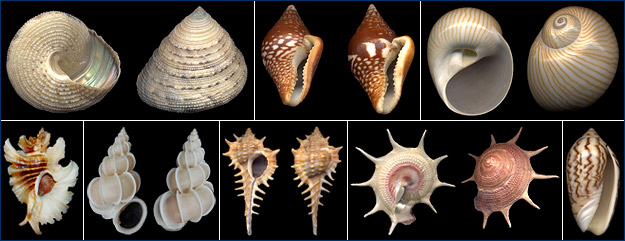
Some shells are spiral and have an operculum to act as a door for when they hide inside. The snail lives in the entire shell (all the way up into the top and retreats inside to hide when it feels threatened or exposed. The operculum blocks any would-be attackers and is made of a material similar to fingernails. These types of molluscs include whelks and moon snails.

Other shells are not spiral and the snail has good suction power so that predators have a difficult time pulling the snail off the rocks. These types of molluscs include slipper snails, abalones, and limpets.


Nudibranch (naked-gills) are sea slugs that have lost the ability to make a shell over evolutionary history. They are still classified as gastropods.

Even though they don't have a shell, they do however have some interesting adaptations to keep from getting eaten. Most nudibranch exhibit warning coloration because they are poisonous or have stingers - none that they make - they acquire them from the prey that they eat!

National Geographic did a great article a few years ago full of lovely photos. Both are linked here. Watch the video for a full-range spectrum of photos.

Thursday, September 29, 2016

Freshwater molluscs?

Most people do not know that there are freshwater clams and mussels in Lake Anna and that they can get as big as the palm of your hand. Nathan, a former student, did his Governor's School project about some of the habitat in the lake and I has asked him to bring in some of these beauties so we could get a good look at them. With the help of his brother, Nathan brought in three little clams for us to enjoy in class.

I found that taking pictures of them in the cup was not easy, but using the document camera, I was able to project an up close view of them onto the wall so that everyone could see the clams and their siphons in detail. Students were able to watch the clams in action. Now that may seem like an oxymoron - clams in action... but there was stuff to see.

You could clearly see the siphons and at times see particles being sucked into the siphons. I put some fish food in the cup and the suction power of the clams was enough to create a current that caused the fish flakes to swirl around in the top of the cup. In first period we were able to watch one of the clams use its foot to dig into the sand to sit upright with its siphons up.

Wednesday, September 28, 2016

Mollusc Pearls

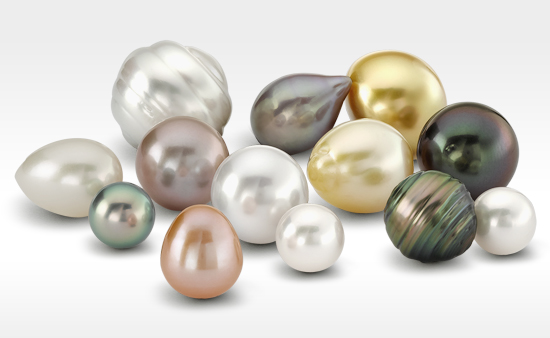
Pearls can be made by any mollusc that has a shell. I passed around my pearls and some shells that I have with pearls on the sides - not all pearls are free floating - they can be attached to the side of a shell.

A mollusc makes a pearl to cover an irritating spot like a piece of sand that gets inside the shell. Pearls can be "glued" to the side of the shell or free to move inside the mollsucs shell. We prefer the "free" kind.

Here is a great short video that explains the process!


Any mollusk that produces a shell can produce a pearl. Nevertheless, naturally occurring pearls are rare, found in perhaps one of every 10,000 animals. The cultured pearl industry, which has flourished since the early 20th century, has developed techniques to greatly improve these odds. Indeed, more pearls are produced now than at any time in human history.( SOURCE This is a good website for lots of information on pearls)

Tuesday, September 27, 2016

Mollusc Basics - Chitons and Bivalves

Students are in the midst of Unit 4 Molluscs busily learning about the different classes of Molluscs and trying to learn a variety of sea shells. Students have learned the basics about sea shells
  • The shells found on the beach are from dead organisms.
  • Any mollusc that has a shell, makes it shell.
  • Sea shells are made of calcium carbonate.
  • Shells are smooth on the inside because slimy molluscs don't want to rub their soft bodies on something rough. If they are smooth on the outside, then the mollusc also wears its body on the outside of its shell.

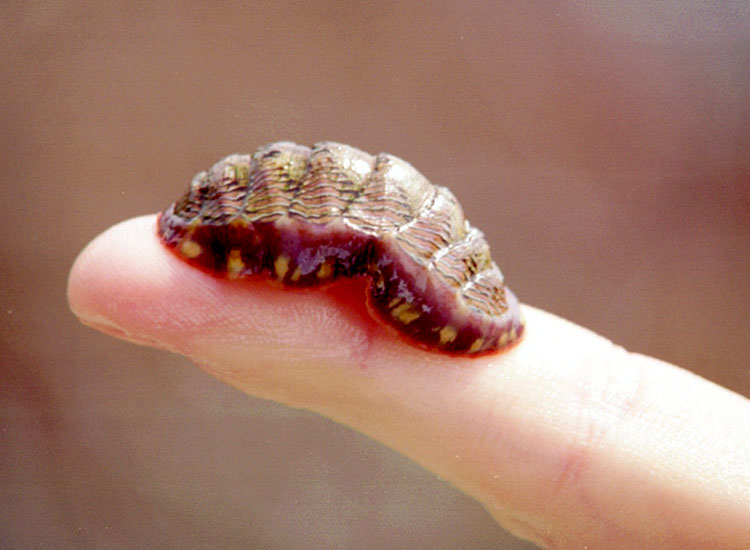
Today's cool mollusc was the chiton, an odd mollusc that has 8 overlapping plates held together by its soft squishy mantle, and the plates come apart when the animal dies. Chitons are built like armored cars and have great suction to stay on the rocky coast in waves and storms. They spend their days sliming around scraping algae. When pulled off a rock, it can roll into a ball to protect its squishy parts. More info can be found here

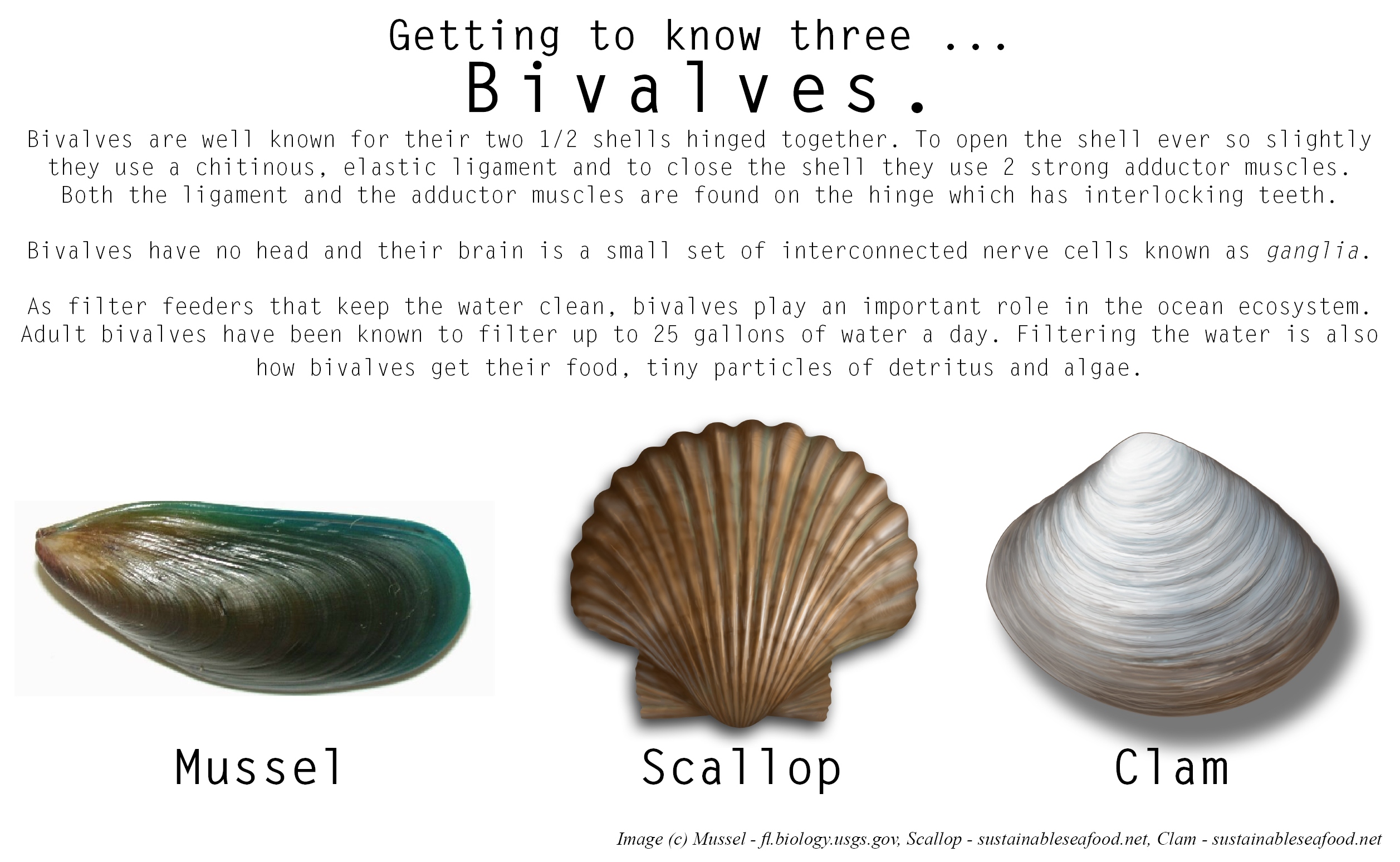
Students also learned the four major classes of bivalves - clams, mussels, oysters, and scallops. Bivalves have 2 shells and 2 siphons, as well as adductor muscles to help keep their shells from opening for hungry predators. Bivalves include some of the more well know shellfish like scallops, clams, oysters, and scallops as well as a few like jingles, ark shells, and cockles. Pictured to the right are a clam (tan), oyster (grey), and mussel (black).

Mussels make byssal threads for attaching (so do ark shells and jingle shells) and scallops have eyespots to see predators. Oysters make cement to stick together and clams have a powerful foot for digging down and hiding.

Thursday, September 15, 2016

Coral Reef basics

We finished class by discussing coral reefs and passing around coral skeletons made of calcium carbonate that I have collected on my travels and inherited from my grandmother. Each hole in the coral houses a polyp... and all the polyps make up the coral colony. So the polyps make up a superorganism. We then watched some BluePlanet and learned about some of their predators like the crown of thorns sea star and saw how the corals that sometimes look like rocks are able to attack and eat each other.


Wednesday, September 14, 2016

Biomes II

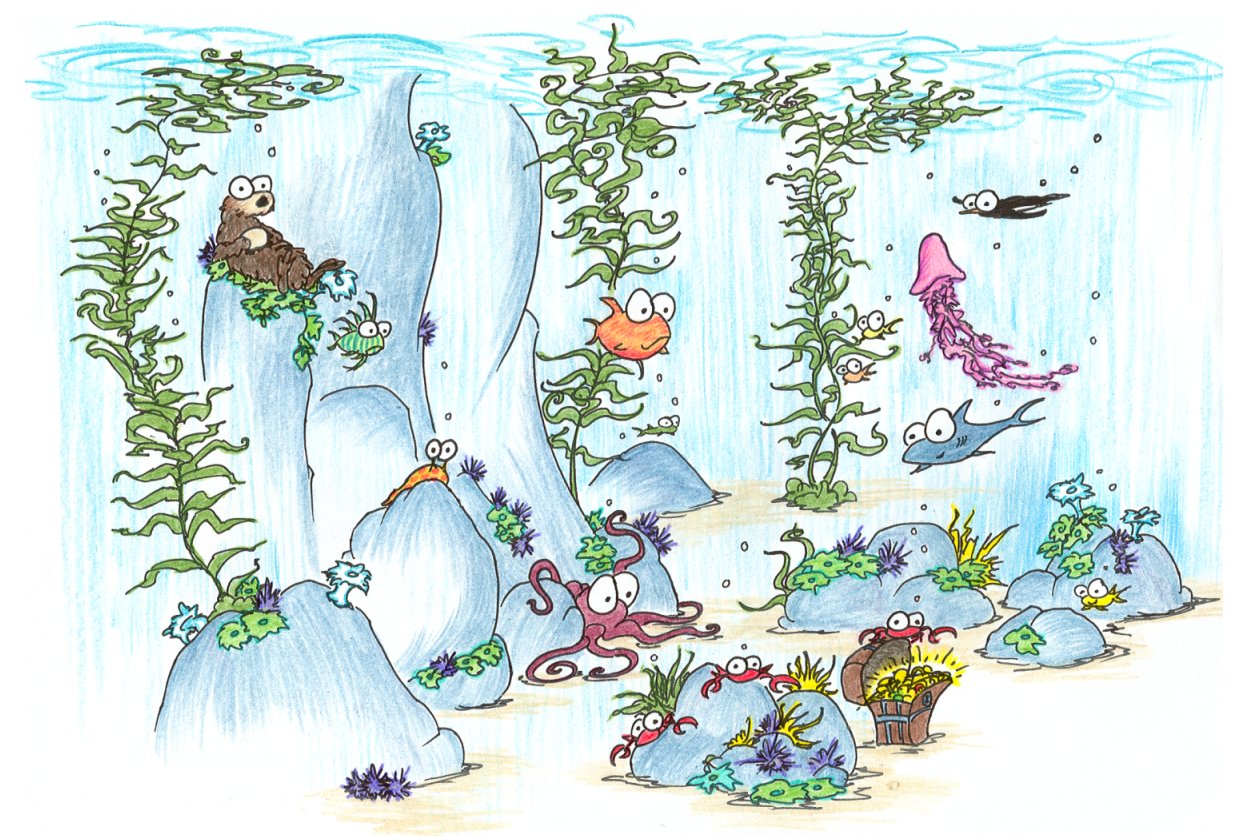
Students have been learning all the different biomes that exist in the oceans. Most people have heard of coral reefs and think about the beach, but there are actually many different biomes in the ocean. Not all biomes are found at the bottom of the sea. Along coasts you can find rocky coasts, sandy beaches, salt marshes, mangroves, sea grass beds, kelp forests, and fouling communities.

Kelp forests are dominated by kelp that can grow to 300 feet tall. The kelp is held near the surface by lots of air bladders. Kelp forests are important because they provide a lot of substrate and habitat for organisms to live, hide and eat.

We also discussed sea grass beds. Sea grass is super-important for stabilizing the substrate and holding the sand down. This promotes water clarity and decreases turbidity. Nothing eats sea grass when it is alive except for manatees. Everything else eats it after the bacteria have decomposed it a bit.

Salt Marshes are one of the most productive ecosystems, but nothing eats the salt marsh grass when its alive... once the anaerobic bacteria break it down into black mush, then other organisms eat it.

Mangroves are trees that can grow in salt water. They have crazy prop roots or finger like roots called pneu- mato- phores that stick up out of the water so the tree can get oxygen during high tide. The roots provide a lot of substrate that a lot of fouling organisms will colonize and use as habitat. 

Photic vs Aphotic is an odd one involving the light and dark zones of the ocean. Some organisms hide in teh dark aphotic zone during the day and migrate up to the surface (the photic zone) at night to eat the phytoplankton. Predators also migrate to eat the things that are eating the phytoplankton. 

There is a lot of information to learn this unit. The Unit 3 Test is one of the hardest of the year.

Tuesday, September 13, 2016

Biomes in the Ocean

Students have been learning all the different biomes that exist in the oceans. Most people have heard of coral reefs and think about the beach, but there are actually many different biomes in the ocean.

One of the weirdest, but also most interesting is Whalefall. Whalefall is when a dead whale settles to the bottom of the ocean and organisms move in to feed on the carcass until even the bones are decomposed. Hagfish are a dominant scavenger as well as bacteria. It may not seem like a big deal, but this biome boasts over 160 species that are not found on the surrounding benthos. More info can be found at the link above, or here. Listen to a podcast here.

Deep sea benthos is another biome and it is pretty boring. Its a gooey squishy substrate populated by some dd scavengers, but there is not a high biodiversity and not a lot of food to eat.

Not all biomes are found at the bottom of the sea. Along coasts you can find rocky coasts, sandy beaches, salt marshes, mangroves, sea grass beds, kelp forests, and fouling communities.

I think fouling communities are really interesting... because all these organisms need is a hard substrate (surface) to stick on. This could be a dock, a pier, a boat, or anything that's in the water long enough. Most people have seen all the 'stuff' growing on the pole legs of piers and docks, but don't really think of the variety of organisms that grow there - or their importance. Most of these organisms are filter feeders and do a lot for water quality. They also break down the surfaces like scavengers... not something we want for our boats and docks we use, but important nonetheless.

There is a lot of information to learn this unit. Students will be given two review sheets - one general, one biome specific. The Unit 3 Test is one of the hardest of the year, and it will be soon.

Computer Lab Etiquette

You are in the computer lab to do work for this class. If you are not doing work, then we will have problems.

Do not pack up early. Work until the bell or until MsJ says.

SAVE OFTEN. And if you save to a key, also save it to your number. If you lose it, you will have to do it again.

If MsJ asks for your attention, stop what you are doing and listen to what she has to say.

You may watch videos about your organism through reliable websites.

You may listen to music through the computer if you have your own headphones. Rule1 MsJ cannot hear it. You get one warning. Rule2 Turn it on and listen – no million clicks and constant changing. Take both ear phones out when MsJ is talking.