Friday, February 26, 2016

Coral Reef Basics

We finished class by discussing coral reefs and passing around coral skeletons made of calcium carbonate that I have collected on my travels and inherited from my grandmother. Each hole in the coral houses a polyp... and all the polyps make up the coral colony. So the polyps make up a superorganism. We then watched some BluePlanet and learned about some of their predators like the crown of thorns sea star and saw how the corals that sometimes look like rocks are able to attack and eat each other.


Thursday, February 25, 2016

Biomes II

Students have been learning all the different biomes that exist in the oceans. Most people have heard of coral reefs and think about the beach, but there are actually many different biomes in the ocean. Not all biomes are found at the bottom of the sea. Along coasts you can find rocky coasts, sandy beaches, salt marshes, mangroves, sea grass beds, kelp forests, and fouling communities.

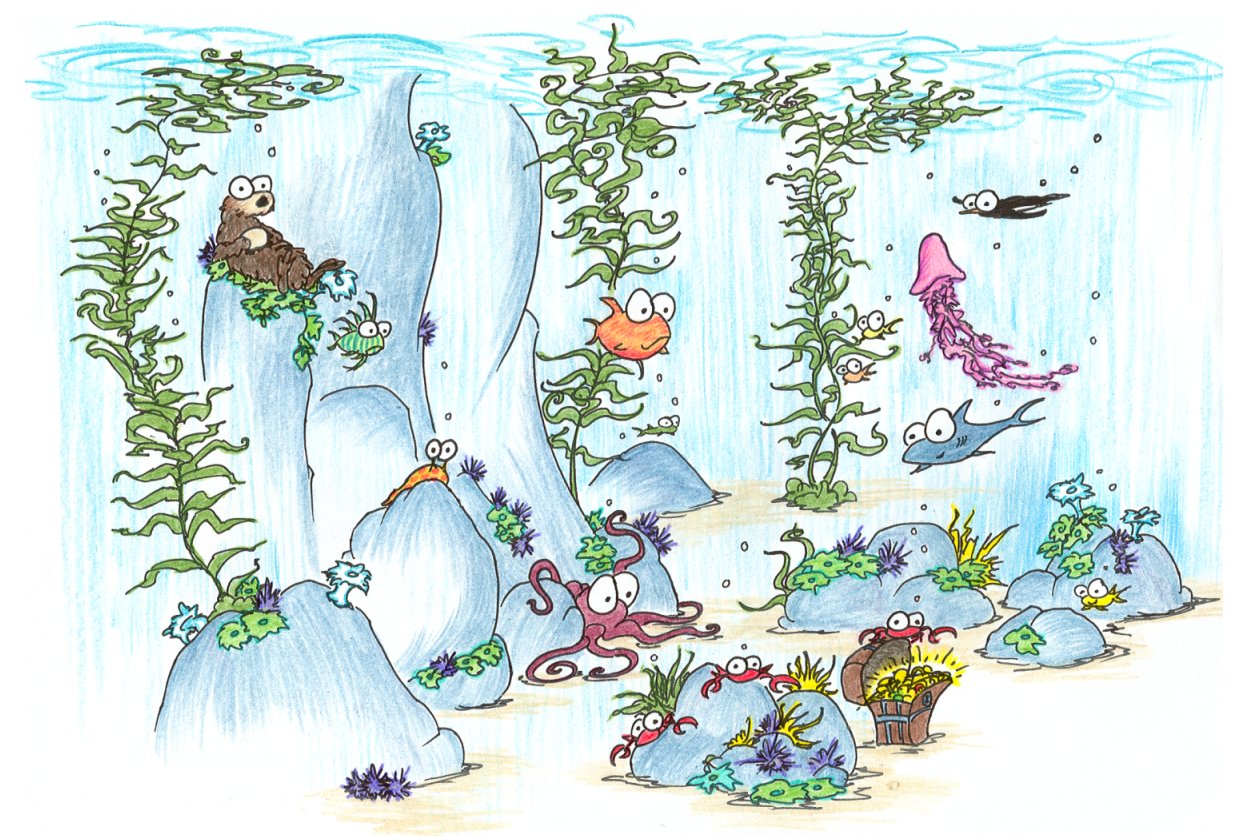
Kelp forests are dominated by kelp that can grow to 300 feet tall. The kelp is held near the surface by lots of air bladders. Kelp forests are important because they provide a lot of substrate and habitat for organisms to live, hide and eat.

We also discussed sea grass beds. Sea grass is super-important for stabilizing the substrate and holding the sand down. This promotes water clarity and decreases turbidity. Nothing eats sea grass when it is alive except for manatees. Everything else eats it after the bacteria have decomposed it a bit.

Salt Marshes are one of the most productive ecosystems, but nothing eats the salt marsh grass when its alive... once the anaerobic bacteria break it down into black mush, then other organisms eat it.

Mangroves are trees that can grow in salt water. They have crazy prop roots or finger like roots called pneu- mato- phores that stick up out of the water so the tree can get oxygen during high tide. The roots provide a lot of substrate that a lot of fouling organisms will colonize and use as habitat. 

Photic vs Aphotic is an odd one involving the light and dark zones of the ocean. Some organisms hide in teh dark aphotic zone during the day and migrate up to the surface (the photic zone) at night to eat the phytoplankton. Predators also migrate to eat the things that are eating the phytoplankton. 


There is a lot of information to learn this unit. The Unit 3 Test is one of the hardest of the year.

Wednesday, February 24, 2016

Biomes in the Ocean

Students have been learning all the different biomes that exist in the oceans. Most people have heard of coral reefs and think about the beach, but there are actually many different biomes in the ocean.

One of the weirdest, but also most interesting is Whalefall. Whalefall is when a dead whale settles to the bottom of the ocean and organisms move in to feed on the carcass until even the bones are decomposed. Hagfish are a dominant scavenger as well as bacteria. It may not seem like a big deal, but this biome boasts over 160 species that are not found on the surrounding benthos. More info can be found at the link above, or here. Listen to a podcast here.

Deep sea benthos is another biome and it is pretty boring. Its a gooey squishy substrate populated by some dd scavengers, but there is not a high biodiversity and not a lot of food to eat.

Not all biomes are found at the bottom of the sea. Along coasts you can find rocky coasts, sandy beaches, salt marshes, mangroves, sea grass beds, kelp forests, and fouling communities.

I think fouling communities are really interesting... because all these organisms need is a hard substrate (surface) to stick on. This could be a dock, a pier, a boat, or anything that's in the water long enough. Most people have seen all the 'stuff' growing on the pole legs of piers and docks, but don't really think of the variety of organisms that grow there - or their importance. Most of these organisms are filter feeders and do a lot for water quality. They also break down the surfaces like scavengers... not something we want for our boats and docks we use, but important nonetheless.

There is a lot of information to learn this unit. Students will be given two review sheets - one general, one biome specific. The Unit 3 Test is one of the hardest of the year, and it will be soon.

Tuesday, February 23, 2016

Zonation

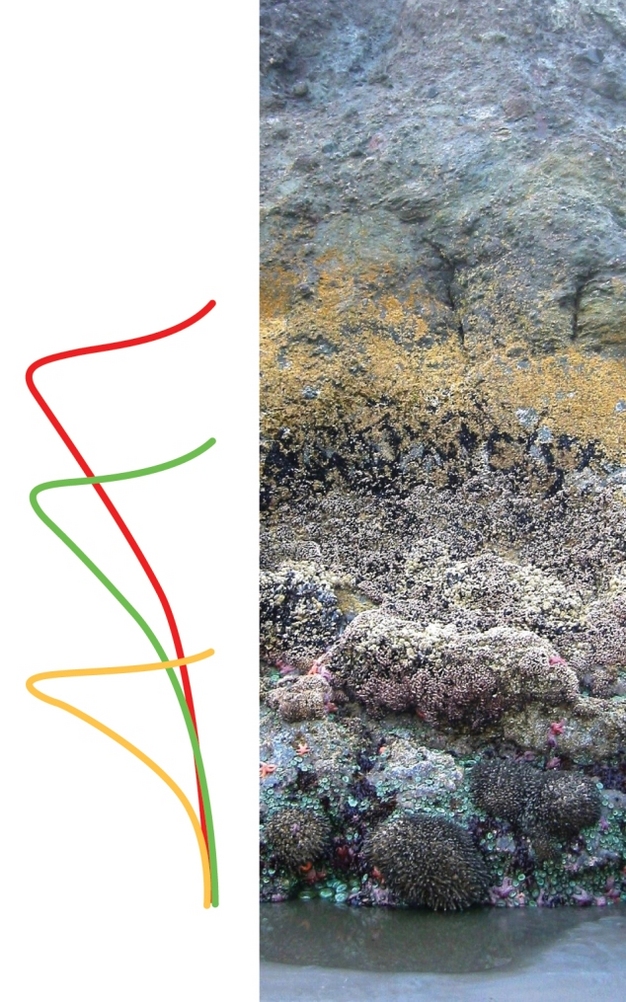
Today we discussed zonation in Marine Ecology. Zonation happens when organisms are adapted to a very specific set of conditions. Because some organisms are better adapted to these certain conditions, we see bands of organisms occupying zones. Today we talked about zonation and specifically how it affects the rocky coastline.


Students identified zones on rocky coast pictures and took notes on the material. Here is an example of a photo where the zones can clearly be seen by changes in dominant seaweeds. The yellow layer is the upper zone and the white pink is the middle zone. It is easy to see the high water mark or where the high tide will reach. You can also see the lichens in the spray zone.

The spray zone is one of the hardest areas to live in because of the huge changes in salinity and temperature.


We also talked about tide pools. Tide pools are depressions that trap water when the tide recedes. You can find all kinds of things in tide pools, but tide pools in the lower zone have a higher biodiversity than tidepools found in the upper zone. This is because they are more often "refreshed" with water that keeps salinity, dissolved oxygen, and the temperature stable, as well as add nutrients and more food! Here is a neat article from National Geographic about tidepools (and where this photo is from).

Monday, February 22, 2016

Types of Seaweed

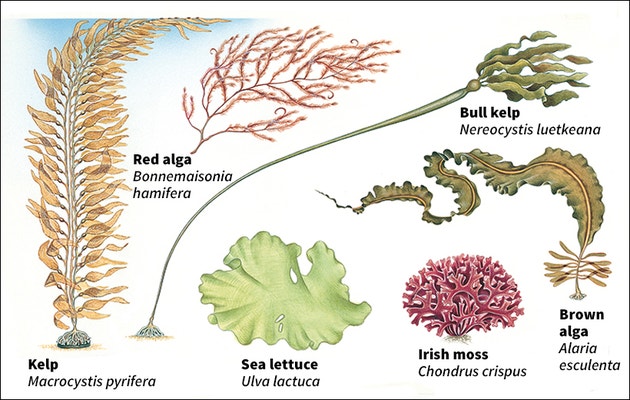
Students learned about the three types of seaweed. Seaweed and algae are the same thing and they are classified by pigment type - red, brown, or green. 

Red seaweeds are the most common, but we don't see a lot of them because they like tropical waters and deep waters. 

Brown algae is the most common seaweed on our coast, whereas green algae is the most common in the freshwater of Virginia.

There is also cyanobacteria - or the blue green algae which we discussed during the plankton part of the unit. 

Some algae is calcareous - meaning it stores calcium carbonate in its tissues. This makes it crunchy and deters herbivores. The most common is a calcareous red algae that makes a pink crust on just about everything left in the ocean.

A lot of seaweed has air bladders to help it float towards the surface.  Air bladders ensure adequate sunlight for photosynthesis. Other important adaptations include flexibility and gels to stay hydrated when the tide goes out. Students observed samples of dried seaweed.

Wednesday, February 17, 2016

Plankton Introduction


Today students got new seats and started a new unit on Plants, Plankton, and Biomes. This is probably our longest and most difficult unit because of the large amount of information that needs to be learned and applied.

We started class with a discussion about phytoplankton (cyanobacteria pictured above) and its importance to the ocean and to the world. Phytoplankton are responsible for feeding most of the creatures that live away from the shore and they are important for adding oxygen both to the water and to the atmosphere.

We are learning about plankton! Plankton include organisms that drift through the seas that cannot swim and do not attach to the bottom. Plankton can be classified a variety of ways.

The first way is to classify them by size. Microplankton and nannoplankton require a microscope if you want to see them because they are so tiny. Macroplankton are small, but you can see them without a microscope. Megaplankton are big enough to pick up and include things like jellies.

Another easy way to classify plankton is into plants and animals. Phytoplankton are tiny plants that photosynthesize and make their own food. Zooplankton (belong in the the zoo) and are animal plankton.

Plankton can also be classified as holo- plankton and mero- plankton. Holo- plankton are plankton for their whole lives (forever) and meroplankton are only plankton for part of their lives. The meroplankton may be plankton when they are eggs, larvae, juveniles, all of those stages, or only some of those stages. Most of the invertebrates and fish in the ocean spend some time in their life as a plankton because it allows them to spread around the ocean and find new places to live. This photo is a meroplankton snail larvae that grows into a poisonous cone snail. Part of its body hardens in to the shell it carries for the rest of its life. This is my favorite website about plankton and it is where all my photos come from. Check out the other types of meroplankton.

Students have drawn their own plankton, tried to match meroplankton to the adult forms, and are currently designing plankton to compete in the Plankton Grand Prix - where the object is to sink slowly.

Wednesday, February 10, 2016

Parasitism

A really gross human parasite is the botfly. You can listen to a podcast about a scientist who was infected with a botfly larvae. Botfly larvae are transferred to humans by mosquito bites and the larvae grow bigger and develop under the skin feeding on the host. This scientist was a bit strange and decided to allow the botfly larvae to develop on his head until it grew enough to leave on its own. A little gross. You can listen the podcast here. Of course then we had to see a video of one getting removed. Also gross. Here's a video from AnimalPlanet, although not the one I showed class.

You can watch a video about the candiru fish in the Amazon that swims into other fish's gills and sucks their blood - not so bad - except urine smells the same, so when people are in the water peeing, it is attracted to the people and swims up their urethras. Ouch.

Computer Lab Etiquette

You are in the computer lab to do work for this class. If you are not doing work, then we will have problems.

Do not pack up early. Work until the bell or until MsJ says.

SAVE OFTEN. And if you save to a key, also save it to your number. If you lose it, you will have to do it again.

If MsJ asks for your attention, stop what you are doing and listen to what she has to say.

You may watch videos about your organism through reliable websites.

You may listen to music through the computer if you have your own headphones. Rule1 MsJ cannot hear it. You get one warning. Rule2 Turn it on and listen – no million clicks and constant changing. Take both ear phones out when MsJ is talking.