
Plankton had to start sinking within one minute and sink slowly. Slowest sinker wins.
Plankton want to stay near the surface for access to sunlight if they are phytoplankton and access to phytoplankton to eat if they are zooplankton.
 Today students got new seats and started a new unit on Plants, Plankton,
and Biomes. This is probably our longest and most difficult unit
because of the large amount of information that needs to be learned and
applied.
Today students got new seats and started a new unit on Plants, Plankton,
and Biomes. This is probably our longest and most difficult unit
because of the large amount of information that needs to be learned and
applied. We are learning about plankton! Plankton include organisms
that drift through the seas that cannot swim and do not attach to the
bottom. Plankton can be classified a variety of ways.
We are learning about plankton! Plankton include organisms
that drift through the seas that cannot swim and do not attach to the
bottom. Plankton can be classified a variety of ways.


 Mutualism is the relationship that is best understood because both organisms benefit - although the advantages are not often clear to us. Pictured to the left are an alligator and plover, eel and cleaner shrimp, and zebra and finch - all of these are cleaning relationships. The smaller organism eats parasites and gets a meal and the larger organisms will not eat it as well as get the benefit of being cleaner (less infection and disease). The bottom right picture is a blind bulldozer shrimp and a goby fish. They share a dwelling that the shrimp builds, and the fish lets the shrimp know when trouble is coming. (Photos from this cool blog)
 Active camouflage is when an organism can actually change the color of its skin to match a background or flash colors to confuse predators and prey. Watch the Kings of Camoflage video about cuttlefish in the sidebar for more information.
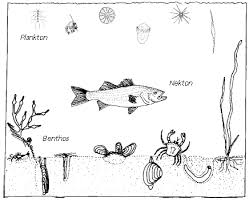 Today in class we discussed different lifestyles. Organisms can be plankton and spend their lives floating and drifting. Nekton means they can swim. Benthic organisms, or organisms that spend their time on the bottom can be attached, can crawl, walk, and some swim - but if they swim they swim along the bottom and spend most of their time resting on the bottom.

 Today the class was spent working independently on the seafloor features surrounding the United States and reading and answering questions about underwater vehicles. Submarines are larger than submersibles and carry more people and can go longer distances. ROVs and AUVs are robots like remote-controlled cars, but go underwater. ROV's have a tether (cord) connecting them to power and AUVs do not.


 |


