Saturday, September 6, 2014

Parasitism

A really gross human parasite is the botfly. You can listen to a podcast about a scientist who was infected with a botfly larvae. Botfly larvae are transferred to humans by mosquito bites and the larvae grow bigger and develop under the skin feeding on the host. This scientist was a bit strange and decided to allow the botfly larvae to develop on his head until it grew enough to leave on its own. A little gross. You can listen the podcast here. Of course then we had to see a video of one getting removed. Also gross. Here's a video from AnimalPlanet, although not the one I showed class.

You can watch a video about the candiru fish in the Amazon that swims into other fish's gills and sucks their blood - not so bad - except urine smells the same, so when people are in the water peeing, it is attracted to the people and swims up their urethras. Ouch.

Friday, September 5, 2014

Symbiosis


Mutualism is the relationship that is best understood because both organisms benefit - although the advantages are not often clear to us. Pictured to the left are an alligator and plover, eel and cleaner shrimp, and zebra and finch - all of these are cleaning relationships. The smaller organism eats parasites and gets a meal and the larger organisms will not eat it as well as get the benefit of being cleaner (less infection and disease). The bottom right picture is a blind bulldozer shrimp and a goby fish. They share a dwelling that the shrimp builds, and the fish lets the shrimp know when trouble is coming.


Parasitism involves things that give us the heebie jeebies. These parasites take advantage of their host, usually feeding on the host, and benefit. The host gets no benefits and over the long term is harmed. Pets can get a lot of different kinds of parasites. Some are internal and some are external.


Commensalism is when one organism benefits and the other is unaffected. So one gets all these advantages from the other... but the other doesn't get a benefit from it and isn't harmed by it.These pilotfish are always with the shark using him as a predator deterrent, but the shark never eats them and doesn't benefit from them in anyway.

Thursday, September 4, 2014

Sexual Dimorphism

Sexual Dimorphism is when males and females exhibit different characteristics. These usually involve, color, size, behavior, and other appendages. 

In the animal kingdom, males are typically brighter and more colorful. The males are trying to prove to the ladies that they have good genes, they are disease free, and they can escape predators. 

Larger males can win contests against other males also proving their good genes. Though the males show off, it is the female's choice when she ultimately makes a decision. It is possible for a female to reject all males and choose none. 

Differences in size and coloration indicate that there is female choice, the female will choose a male to fertilize her eggs and in most cases, his job is done, and she leaves to finish the baby-forming process. All she wanted was his genes. 

When a large group of organisms all spawn at the same time, the organisms rely on luck and statistical chance for genetic variation. Males and females will look similar because there is no choice involved.

When males and females work together and take an equal role in raising young or protecting eggs, the males and females tend to look more similar. They look similar because of their equal roles and because the choice is longer-lasting. She is looking for more than just a pretty face (and pretty faces in the animal world do not indicate good egg care or being able to provide nesting materials, food, etc).

Differences in size between males and females varies widely. There is no set rule for who will be bigger, but there is usually a clear reason as to why one of them is bigger. Males can be bigger because they fight other males, because they have to guard eggs, or other reasons. Females can be bigger because they have to carry and nourish a fetus, carry and develop eggs, protect babies, or other reasons. To know why a male is bigger or a female is bigger the biology and reproductive strategies have to be understood.

Wednesday, September 3, 2014

Bioluminescence

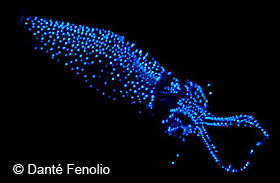
Different colors of light travel different lengths. Blue travels the farthest, but red, orange and yellow do not travel far. Because red does not travel far, these organisms appear black.

After discussing bioluminescence (organisms that can produce their own light) we looked at a TED talk by David Gallo . Gallo's talk showed the organisms in accurate color and in motion. His talk also showed some amazing footage of cephalopods like cuttlefish and octopus performing magical feats of mimicry and camouflage. You should definitely follow the link and watch this video stream.

His talk was based on research by Dr. Widder. We looked at some of her photos and you can learn more about her work and see her presentation here.

When it comes to deep sea creatures - some bioluminesce and some don't. People are fascinated with the gulper eel, a four foot long eel that has a HUGE jaw. It has such a big mouth so that it can eat anything it comes in contact with because in the deep ocean, meals may be far and few between. More information about the gulper eel and other deep sea creatures can be found at Sea & Sky's Website.

You can watch a this one found on YouTube.  This creature to the right is a Firefly Squid; it has amazing lighting capabilities.

For more information check out
The Bioluminescence Web Page
How Stuff Works
Or Sea and Sky's page about Bioluminescence.

Intro to Color in the Sea

We talked about fish coloration and camouflage. Some of the tricks these fish have up their fins to blend in or advertise or trick predators are quite ingenious. 

One of my favorite organisms is the nudibranch - basically a slug that lives in the ocean. These soft squishy slimy critters would make excellent snacks, but they are all poisonous! They have warning coloration to let would-be predators know that they would not taste good at all. You can click here for a National Geographic Article about nudibranchs.

Tuesday, September 2, 2014

Plankton Nekton Benthos

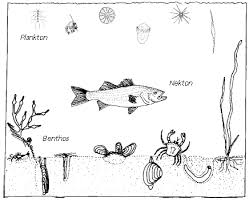
Today in class we discussed different lifestyles. Organisms can be plankton and spend their lives floating and drifting. Nekton means they can swim. Benthic organisms, or organisms that spend their time on the bottom can be attached, can crawl, walk, and some swim - but if they swim they swim along the bottom and spend most of their time resting on the bottom.

Next we discussed eating. Producers don't eat - they can make their own food. Producers starts with P and so does Plants and PhytoPlankton.

Herbivores eat plants, Carnivores eat meat, and Planktivores eat plankton. Students worked on a worksheet sorting organisms into their varying lifestyles and eating preferences to finish class.

Monday, September 1, 2014

Parrotfish


Parrotfish are part of the nekton because they swim. They are omnivores because they eat coral (animal) and algae (plants). This fish is a male because it is more colorful than its female counterpart. Some may consider this warning coloration because it will chomp on things that try to mess with it. An odd part of their niche is that the coral they digest is where most of the white sand in tropical locations comes from.

Computer Lab Etiquette

You are in the computer lab to do work for this class. If you are not doing work, then we will have problems.

Do not pack up early. Work until the bell or until MsJ says.

SAVE OFTEN. And if you save to a key, also save it to your number. If you lose it, you will have to do it again.

If MsJ asks for your attention, stop what you are doing and listen to what she has to say.

You may watch videos about your organism through reliable websites.

You may listen to music through the computer if you have your own headphones. Rule1 MsJ cannot hear it. You get one warning. Rule2 Turn it on and listen – no million clicks and constant changing. Take both ear phones out when MsJ is talking.