Tuesday, August 12, 2014

Welcome Back Fall 2014

Greetings students, parents, and guardians. Welcome back to a new school year with Ms Jancaitis! Welcome to Marine Ecology! This blog has been set up to connect students, parents, and guardians with the marine ecology class.

In class, each student will receive a course syllabus and safety rules. They need to be read and signed by both the student and parent guardian. The course syllabus outlines what the course will be like, what topics will be covered, and course expectations. It also contains contact information. There will be a quiz on this syllabus and classroom procedures on Friday. The Safety Test (with a bit of latitude and longitude) will be Monday.

The safety rules are rules designed to keep the classroom safe and orderly to maximize learning and prevent accidents and injuries. These rules need to be studied because there will be a safety test on Monday and infractions of these rules can lead to disciplinary action as well as low assignment grades. A breakage sheet is a contract holding students accountable for the items that are broken if the student is acting a manner that is unsafe for themselves or those around them.


Please have these papers signed and returned as soon as possible. Students not returning signed safety rules and breakage sheets will not be able to participate in labs and activities until the contracts are signed and returned.

Monday, August 11, 2014

It's Shark Week!

It's hard not to get excited about Shark Week on Discovery... Sharks are such interesting sea animals. They have more senses than us weak humans and it really is a good thing that they do not actively hunt or want to eat humans! Just be aware that a lot of the programming these days is in a mock-umentary style and may not be presenting facts!

My best friend has been featured on "Great White Highway" that is sometimes shown during Shark Week. EEEK! If you see her she's that red pony tail right in the center. Mel has been studying elephant seals, a favorite prey item on the great white shark.

At Shark Week's Website you can "Shark Yourself," and although the controls are a bit strange, the results are more than amusing. Check it out here.

This is a cool interactive http://dsc.discovery.com/sharks/shark-anatomy.html

Thursday, May 8, 2014

Skates & Rays

Today in class we talked about skates and rays. Skates and rays are depressed relatives of sharks that often spend most of their time on the benthos. (There are a few exceptions like manta rays pictured in the upper right)

Skates and rays are really similar and often hard to tell apart. Some rays look like flat sharks and some flat sharks look like rays, so we are going to be general in identifying skates and rays. In general, skates have fins on the tips of their tails.

Only rays can have stingers, and not all of them do. They can have 1 to 3 stingers from 5 to 15 inches long. See the picture below.

I often get asked about Steve Irwin, the famous Crocodile Hunter when we talk about stingrays. Yes, Steve Irwin was killed by a stingray, but his type of accident was very rare. Steve got stabbed in the heart which injected venom right into an important organ. Also, he removed the barb which caused just as much damage going in as it did coming out because of the sharp serrated edge. For more information about Steve Irwin's death check here and here.

Still worried about shark attacks? Check the newest stats here at the Florida site.

Wednesday, May 7, 2014

Shark Finning... YUCK!

Today we discussed conservation of sharks. Millions of sharks are killed each year by humans. Some are caught by sport fisherman, some are harvested for oils, meats, and other things; many of them are being harvested for their fins. Finning wastes 95% of an animal, and the sharks are often tossed back in the ocean alive after being finned to die a slow painful death. For more information, click here.

The fins are harvested for shark fin soup. Shark fin soup is considered a delicacy in some countries and can sell for upwards of a hundred dollars a bowl.


The next thing we talked about was shark attacks. Most shark attacks are actually provoked by humans. Other shark attacks like bump-and-bites and hit-and-runs are the shark investigating a human to see if it is something good to eat. Once the shark tries it, it finds it doesn't like humans, it will swim away. Unfortunately for us humans, we are not so tough and kind of squishy and shark attacks damage us.

Tuesday, May 6, 2014

Don't be afraid of Sharks!

These are some of my favorite shark graphics.
Appreciate and LEARN. 
Click on the images to make them larger.


Monday, May 5, 2014

Shark Reproduction

We talked about the history of sharks, common characteristics of cartilaginous fish and then the reproductive strategies of sharks.

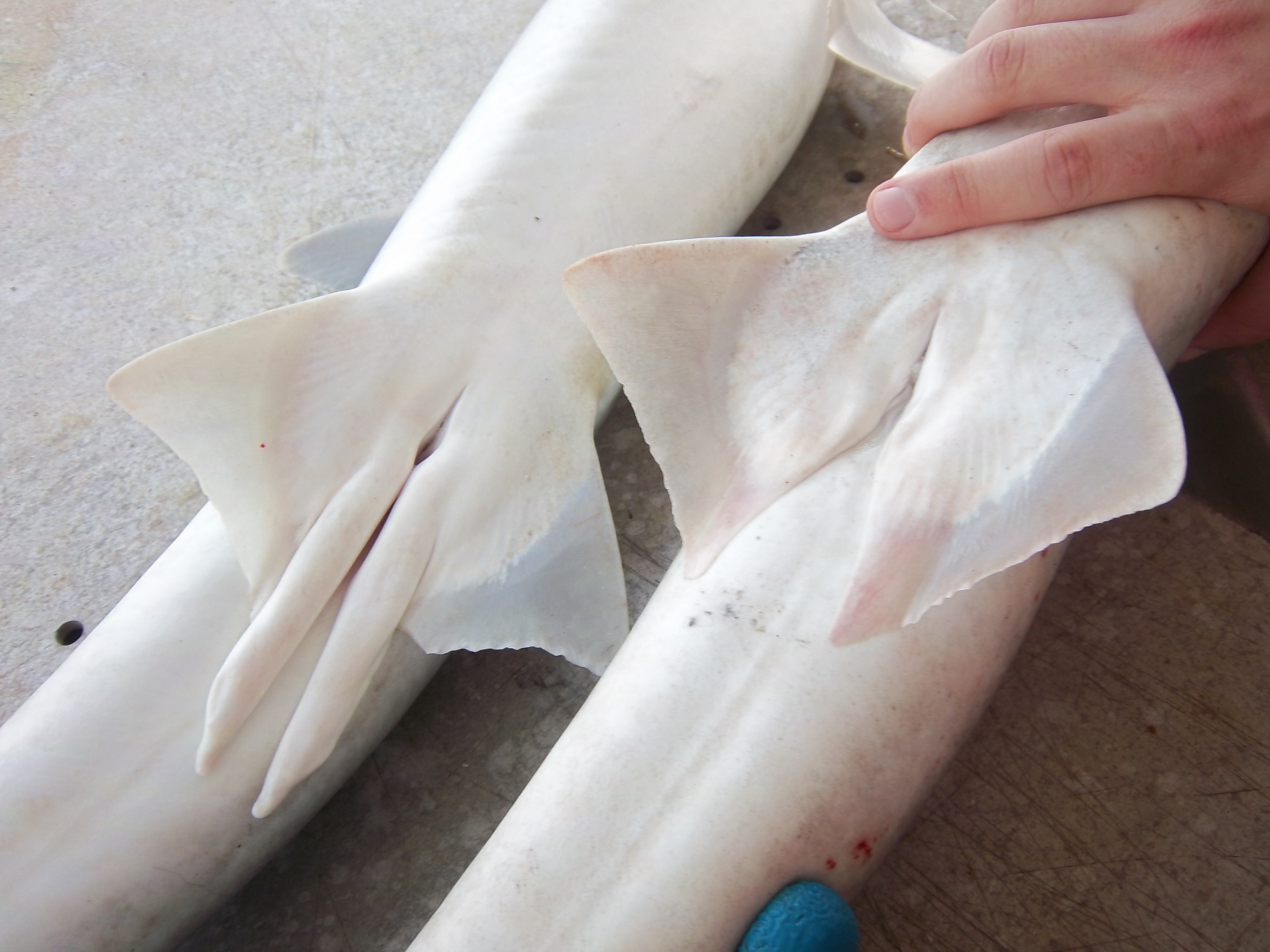
Not a lot is known about shark reproduction because in many cases it has never been observed. Sharks have internal fertilization and the male shark has two claspers for sperm delivery. These can be seen on male sharks protruding from the pelvic fin.

Shark reproduction is violent with males biting the female. As a result female shark skin is much thicker than the males so that this practice does not ham or kill her. She fights a little to ensure that only strong males with good genes are able to fertilize her eggs.

Some sharks are oviparous and lay eggs (pictured). These egg cases are known as mermaid's purses. You can see the baby shark and its nutrient-rich yolk through the leathery egg case.

Some sharks are viviparous and have live birth a lot like mammals.

And some sharks are ovoviviparous and keep their eggs inside the uterus before releasing them... so its making eggs and then kind of having live birth.

Think you know it all? Try "Romancing the Shark," a quiz from Shark Week.

Thursday, May 1, 2014

Shark Senses

Sharks have a large brain to help process the sensory overload they must get from the SEVEN senses they have. They have the five we have plus a lateral line (pressure and vibrations) and the ampullae of lorenzini (electro-reception).

Follow this link for a cool interactive about how shark jaws stick out when they attack their prey! The interactive is down at the bottom.

If you need the shark interactive, click here. 

If you are doing a final project on a shark... check out this new link! www.shark.ch

Computer Lab Etiquette

You are in the computer lab to do work for this class. If you are not doing work, then we will have problems.

Do not pack up early. Work until the bell or until MsJ says.

SAVE OFTEN. And if you save to a key, also save it to your number. If you lose it, you will have to do it again.

If MsJ asks for your attention, stop what you are doing and listen to what she has to say.

You may watch videos about your organism through reliable websites.

You may listen to music through the computer if you have your own headphones. Rule1 MsJ cannot hear it. You get one warning. Rule2 Turn it on and listen – no million clicks and constant changing. Take both ear phones out when MsJ is talking.