Tuesday, May 8, 2012

Time to make it POP!

Windows 7 makes it easier than ever to change the look of your powerpoint with a few easy clicks.

Important points to consider.
  • You earn no points for the color and look of your powerpoint. Spend your time finding the information.
  • Points can be deducted for annoying and hard to read colors, fonts, and animations.
The best way to do change everything is on the ToolBar look for “View” and then choose “Slide Master.” Anything you change while on the Slide Master will change every other slide – this is why it is useful.

On the toolbar look through the “Aa Themes” and choose a design you like. If you hover over it, it will give you’re a preview. You can then change the colors of this theme by looking at the end of the row and pulling down the color tab. So pick a design and pick a color scheme. You can also change the fonts here. Done! When you are done making your changes look on the toolbar for a red X that says “Close Master View.” Then go through and proof your slides. You may need to move some boxes around.
 **Note: White or solid color backgrounds are the clearest and easiest to read.

Currently your powerpoint has an animation scheme called “Appear.” I would advise you not to change that and not to change your transitions as it will distract from your powerpoint.

Please ask MsJ if you have any questions.

Echinoderms

Echinoderm means spiny skin. Echinoderms include sea urchins, sea stars, sand dollars, sea cucumbers and some other odd organisms like feather stars and basket stars. All echinoderms have radial symmetry, spiny skin, and an endoskeleton called a test.

Most people are familiar with an orange sea star because on the east coast, that's all we've got. On the west coast and in other places around the world, it is easier to find a variety of sea stars in other colors and with different amounts of legs.

Sea stars have powerful tube feet that use water suction to open molluscs. When they eat molluscs, they actually stick their stomach into the shells of the mollusc, digest it, and then put their stomach.

Feather stars and basket stars both have crazy looking legs that they wave around to filter feed. Sea urchins and sand dollars are both covered with protective spines and eat with a scraping mouth called Aristotle's Lantern.

Sea cucumbers have lost most of their exoskeleton and are a bit squishier than other echinoderms. Sea cucumbers are important detritus eaters on the sea floor. When attacked by predators they will expel their guts as a meal for the predator as they make a get away. Sea cucumbers are able to regenerate these guts over time.

Monday, May 7, 2012

Mantis shrimp


One cool crustacean we have been learning about is the mantis shrimp. Mantis shrimp have folded claws like a praying mantis. They have lightning quick reflexes and shoot their arms out to smack their prey. It is said that they have enough power to break aquarium glass. If you want to see an interesting video of a mantis shrimp attacking and eating different prey - check here.

Crustacean Review

CRABS - In general, you can tell the difference between boy crabs and girl crabs by looking at the shape of the plate on the abdomen. Boys have a thinner more pointy plate, girls have a wider more rounded plate because it is used to hold the egg mass. The mothers carry the eggs because not many predators will mess with them to get to the eggs.

  • Blue Crabs are found in the Chesapeake Bay. They are very agressive, like to pinch, but are good to eat. They have a pointy-ended shell and swim fins. (you can kind of see the swim fins on the last leg of the crabs on the right)
  • Spider Crabs have a rounder body shape, often a bumpy shell that will grow algae for camouflage, and longer more spindly legs. Spider Crabs include snow crabs and king crabs like the ones seen on Deadliest Catch. A decorator crab is a kind of spider crab that attaches stuff to its bumpy shell to blend in.
  • Fiddler Crab males have one claw that is a lot bigger than the other. This is for impressing the ladies, and used to show dominance over other males. 
  • Hermit Crabs have a weak exoskeleton and thus protect it with a stolen mollusc shell. They have adapted to this lifestyle and have modified back legs that hook on the inside to hold the shell on and one claw that is slightly larger to use as an operculum.

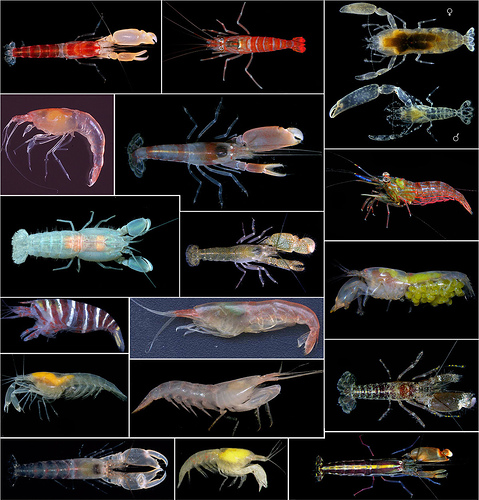
SHRIMP - miniature lobsters... use their swimmerettes to keep themselves moving - most Americans have never seen one with its head and legs still attached!
  • Gulf shrimp are the ones people most people are familiar with because these are the ones we eat!
  • Shore shrimp live in sea grasses, are fairly small and clear, and are not commercially harvested because no one would make any money.
  • Snapping shrimp (or pistol shrimp) have slightly larger claws and can use them to make sonic waves to stun their prey with sound. 
  • Mantis shrimp whack their prey with arms that can unfold and strike lightning quick. 
  • Cleaner shrimp make their living eating parasites off of fish and other sea creatures. 

BARNACLES
If you look at a diagram, barnacles are like little shrimp glued on their backs with a white fence around them. They stick their feathery legs out to filter feed plankton. They are plankton for a while and once settled and glues onto a hard substrate never move again. This makes mating difficult, but the hermaphroditic barnacles have special talents. Gooseneck barnacles have a stalk that they attach to substrates with.

Thursday, May 3, 2012

2012 Virginia Beach Aquarium

Yesterday, the marine ecology classes went to the Virginia Aquarium and for a short walk on the beach. Everyone I talked to had a fabulous time, even if at times it was a long walk, hot, hungry, tiring, or wet (bad grammar intentional). If you took photos, please bring them in and I will make them available to others.

Here is how you get to the ones I have already.
Go to My Computer --> Classes --> Science --> Jancaitis Stuff --> Field Trip.


Monday, April 30, 2012

Crustacean Basics and Lobsters


Crustaceans have bilateral symmetry and a hard crunchy exoskeleton. Because the crustacean grows and the exoskeleton does not, crustaceans have to molt or shed their hard outercovering, exposing a new softer bigger covering that will harden in a few days.

LOBSTERS
There are two basic lobsters to be familiar with - the clawed lobster and the spiny lobster. Both are primarily scavengers. The clawed lobster has two different claws - a lighter faster shredder and a heavier more powerful crusher. The clawed lobster is more solitary because it is more aggressive. The spiny lobster does not have big claws, but can defend itself with its long whip like antennae. This lobster likes to congregate in groups and is not as aggressive. Both lobsters carry their eggs on the swimmerettes protecting them from potential predators.

Monday, February 6, 2012

Welcome!

Greetings students, parents, and guardians.

Welcome to a new school year with Ms Jancaitis & Mr. Scharf! This blog has been set up to connect students, parents, and guardians with the marine ecology class.

At Open House or in class, each student will receive a course syllabus, safety rules, and a breakage sheet. The safety rules and breakage sheet needs to be read and signed by both the student and parent guardian.
  1. The course syllabus outlines what the course will be like, what topics will be covered, and course expectations. It also contains contact information. There will be a quiz on this syllabus on Thursday.
  2. The safety rules are rules designed to keep the classroom safe and orderly to maximize learning and prevent accidents and injuries. These rules need to be studied because there will be a safety test on Friday and infractions of these rules can lead to disciplinary action as well as low assignment grades.
  3. A breakage sheet is a contract holding students accountable for the items that are broken if the student is acting a manner that is unsafe for themselves or those around them.
Please have these papers signed and returned by Friday. Students not returning signed safety rules and breakage sheets will not be able to participate in labs and activities until the contracts are signed and returned. 

Mrs. Woodward, one of the other chemistry teachers, will be on maternity leave this spring and as such, I will be covering her Chemistry and AP Chemistry classes. Mr. Scharf will be conducting the Marine Ecology courses in my place using all my materials. We will be in daily contact and I will be right next door, so class should run smoothly.

Please contact me if you have any questions. 

Computer Lab Etiquette

You are in the computer lab to do work for this class. If you are not doing work, then we will have problems.

Do not pack up early. Work until the bell or until MsJ says.

SAVE OFTEN. And if you save to a key, also save it to your number. If you lose it, you will have to do it again.

If MsJ asks for your attention, stop what you are doing and listen to what she has to say.

You may watch videos about your organism through reliable websites.

You may listen to music through the computer if you have your own headphones. Rule1 MsJ cannot hear it. You get one warning. Rule2 Turn it on and listen – no million clicks and constant changing. Take both ear phones out when MsJ is talking.