Monday, May 7, 2012

Mantis shrimp


One cool crustacean we have been learning about is the mantis shrimp. Mantis shrimp have folded claws like a praying mantis. They have lightning quick reflexes and shoot their arms out to smack their prey. It is said that they have enough power to break aquarium glass. If you want to see an interesting video of a mantis shrimp attacking and eating different prey - check here.

Crustacean Review

CRABS - In general, you can tell the difference between boy crabs and girl crabs by looking at the shape of the plate on the abdomen. Boys have a thinner more pointy plate, girls have a wider more rounded plate because it is used to hold the egg mass. The mothers carry the eggs because not many predators will mess with them to get to the eggs.

  • Blue Crabs are found in the Chesapeake Bay. They are very agressive, like to pinch, but are good to eat. They have a pointy-ended shell and swim fins. (you can kind of see the swim fins on the last leg of the crabs on the right)
  • Spider Crabs have a rounder body shape, often a bumpy shell that will grow algae for camouflage, and longer more spindly legs. Spider Crabs include snow crabs and king crabs like the ones seen on Deadliest Catch. A decorator crab is a kind of spider crab that attaches stuff to its bumpy shell to blend in.
  • Fiddler Crab males have one claw that is a lot bigger than the other. This is for impressing the ladies, and used to show dominance over other males. 
  • Hermit Crabs have a weak exoskeleton and thus protect it with a stolen mollusc shell. They have adapted to this lifestyle and have modified back legs that hook on the inside to hold the shell on and one claw that is slightly larger to use as an operculum.

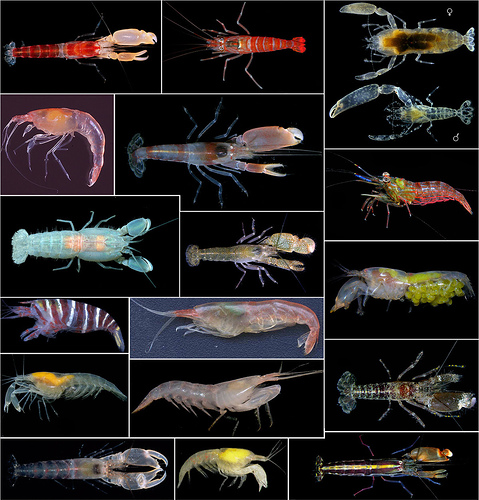
SHRIMP - miniature lobsters... use their swimmerettes to keep themselves moving - most Americans have never seen one with its head and legs still attached!
  • Gulf shrimp are the ones people most people are familiar with because these are the ones we eat!
  • Shore shrimp live in sea grasses, are fairly small and clear, and are not commercially harvested because no one would make any money.
  • Snapping shrimp (or pistol shrimp) have slightly larger claws and can use them to make sonic waves to stun their prey with sound. 
  • Mantis shrimp whack their prey with arms that can unfold and strike lightning quick. 
  • Cleaner shrimp make their living eating parasites off of fish and other sea creatures. 

BARNACLES
If you look at a diagram, barnacles are like little shrimp glued on their backs with a white fence around them. They stick their feathery legs out to filter feed plankton. They are plankton for a while and once settled and glues onto a hard substrate never move again. This makes mating difficult, but the hermaphroditic barnacles have special talents. Gooseneck barnacles have a stalk that they attach to substrates with.

Thursday, May 3, 2012

2012 Virginia Beach Aquarium

Yesterday, the marine ecology classes went to the Virginia Aquarium and for a short walk on the beach. Everyone I talked to had a fabulous time, even if at times it was a long walk, hot, hungry, tiring, or wet (bad grammar intentional). If you took photos, please bring them in and I will make them available to others.

Here is how you get to the ones I have already.
Go to My Computer --> Classes --> Science --> Jancaitis Stuff --> Field Trip.


Monday, April 30, 2012

Crustacean Basics and Lobsters


Crustaceans have bilateral symmetry and a hard crunchy exoskeleton. Because the crustacean grows and the exoskeleton does not, crustaceans have to molt or shed their hard outercovering, exposing a new softer bigger covering that will harden in a few days.

LOBSTERS
There are two basic lobsters to be familiar with - the clawed lobster and the spiny lobster. Both are primarily scavengers. The clawed lobster has two different claws - a lighter faster shredder and a heavier more powerful crusher. The clawed lobster is more solitary because it is more aggressive. The spiny lobster does not have big claws, but can defend itself with its long whip like antennae. This lobster likes to congregate in groups and is not as aggressive. Both lobsters carry their eggs on the swimmerettes protecting them from potential predators.

Monday, February 6, 2012

Welcome!

Greetings students, parents, and guardians.

Welcome to a new school year with Ms Jancaitis & Mr. Scharf! This blog has been set up to connect students, parents, and guardians with the marine ecology class.

At Open House or in class, each student will receive a course syllabus, safety rules, and a breakage sheet. The safety rules and breakage sheet needs to be read and signed by both the student and parent guardian.
  1. The course syllabus outlines what the course will be like, what topics will be covered, and course expectations. It also contains contact information. There will be a quiz on this syllabus on Thursday.
  2. The safety rules are rules designed to keep the classroom safe and orderly to maximize learning and prevent accidents and injuries. These rules need to be studied because there will be a safety test on Friday and infractions of these rules can lead to disciplinary action as well as low assignment grades.
  3. A breakage sheet is a contract holding students accountable for the items that are broken if the student is acting a manner that is unsafe for themselves or those around them.
Please have these papers signed and returned by Friday. Students not returning signed safety rules and breakage sheets will not be able to participate in labs and activities until the contracts are signed and returned. 

Mrs. Woodward, one of the other chemistry teachers, will be on maternity leave this spring and as such, I will be covering her Chemistry and AP Chemistry classes. Mr. Scharf will be conducting the Marine Ecology courses in my place using all my materials. We will be in daily contact and I will be right next door, so class should run smoothly.

Please contact me if you have any questions. 

Thursday, January 5, 2012

Sea Turtle Hatchlings

Baby sea turtles, hatchlings, have a very tough life. Mom digs a nest, deposits her eggs (about 100), and then leaves. She may lay eggs four to six times a season. The eggs are about the size of ping pong balls and a little more flexible (they have a ways to fall).

Later, the hatchlings have to fight their way out of the nest and through sand to the surface... and then make their way to the ocean. One of the biggest threats to hatchlings is photopollution. For more information about how lighting affects baby turtles, click here.


For other threats to Sea Turtles as hatchlings or as adults, check here or here. 

Tuesday, January 3, 2012

Shrimp vs. Turtles

We started discussing marine harvesting and fishing by talking about who harvests the most seafood (China), who eats the most seafood (China), and which people eat the most seafood pounds per person (the Maldives). Americans are about sixth on the list as far as consumption, but we are the number one consumer and importer of shrimp. Importing shrimp is damaging to the environment for two reasons.

1. Shrimp that are farmed in other countries are not as regulated as here in the states, so shrimp farm pollution is not as regulated and it damages coral reefs. Also many mangroves are cleared to build these farms.

2. US boats are required to have turtle excluder devices (TED) on trawl nets so that turtles do not get caught in shrimp nets and drown. Other countries do not regulate this and as a result catch and drown sea turtles.

To make a environmentally responsible seafood choices, choose shrimp that are farmed or caught in the US. For more sustainable seafood choices, check out Seafood Watch.

Computer Lab Etiquette

You are in the computer lab to do work for this class. If you are not doing work, then we will have problems.

Do not pack up early. Work until the bell or until MsJ says.

SAVE OFTEN. And if you save to a key, also save it to your number. If you lose it, you will have to do it again.

If MsJ asks for your attention, stop what you are doing and listen to what she has to say.

You may watch videos about your organism through reliable websites.

You may listen to music through the computer if you have your own headphones. Rule1 MsJ cannot hear it. You get one warning. Rule2 Turn it on and listen – no million clicks and constant changing. Take both ear phones out when MsJ is talking.