Friday, August 13, 2010

Pressure!

Today students began class with a BrainPop on currents and took the quiz. Tim and Moby did an excellent job describing how currents affect global weather patterns. They also explained global water circulation in the global conveyor belt.Click on the photo for a better view.

Students took notes on dissolved oxygen and learned that there is less oxygen available in the water than in the air we breath (12 parts per million vs 200 pmm) and that dissolved oxygen varies with temperature. Cold water holds more DO, just like cold sodas have more carbonation.

Pressure is the weight of particles above you and increases with depth in water. Right now there is one atmosphere of pressure squeezing on all of us, but we are used to it, so we don't notice the difference. We may notice our ears popping when driving over Shenandoah or flying in an airplane when pressure decreases. Water is 800 times more dense than air, so underwater, pressure increases dramatically. Pressure increases one atmosphere with every ten feet of depth, so all you need to do is dive down the deep end of the pool and you will feel an increase in pressure to two atmospheres (one for the water, and one for the air)

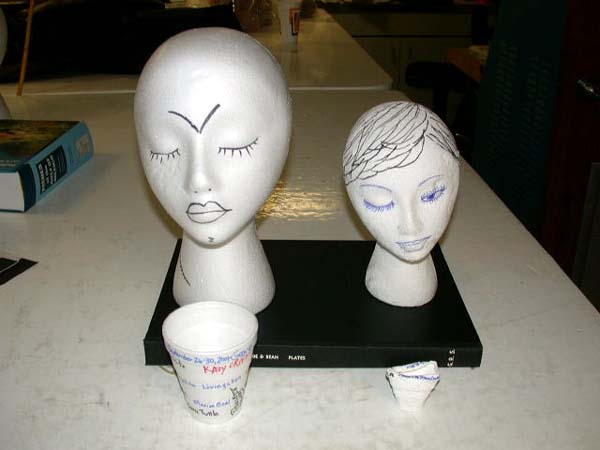
Scientists think it is funny to take styrofoam deep into the ocean because the pressure underwater will squeeze the air out of the styrofoam and "shrink it." Really it is just compressed and more dense. Here is a photo of what happens to styrofoam wig-heads and cups when taken down a few thousand feet, a change of several atmospheres of pressure.
Brittany oversees the boys as Brendan, Brandon, and Bruce try to measure the water correctly

Students finished class with a lab demonstration of how pressure increases with depth using cups of water with three holes. Water squirted further out of the bottom hole because there was more weight and pressure pushing down on that part of the cup. Students did an excellent job working together and cleaning up.
Morgan removes the tape, Micheal holds the ruler, and all try to read the measurements
Carlton peels the tape while Corrinn, Courtney, and Cherie get their measurements
In this photo are Noel, Nate, Rachel, and Tommy

Latitude and Longitude Extra Credit

We watched a BrainPop featuring Tim and Moby hiking in the mountains. They claimed their position was:

60* 5' 22" N       
159* 13' 10" W

For extra credit (up to five people), tell me where they were hiking.

Thursday, August 12, 2010

Oceanography - Salinity, pH, and Currents

Today students got an introduction to oceanography. We discussed the salinity of the ocean (an average of 35 parts per thousand), the pH (the ocean has a pH of 8, which is basic), and currents (water that moves at different rates than the surrounding water because of wind).

Currents can be identified by their temperature, salinity, and density. Students identified which currents were warm and cold by looking at where they are coming from.

Next students learned more about how scientists learn about currents. Students practiced latitude and longitude by plotting some points of a cargo lost overboard and where some of the shipment washed up beaches, then they read articles and answered questions, and finished up by listening to a podcast interviewing Curtis Ebbesmeyer, the oceanographer who studies sneakers, rubber ducks, and other floating debris. You can listen to the podcast here.

In the interview, and in the readings, gyres full of floating plastic debris are discussed. Here is a map showing some of the locations of these gyres. Cick on the picture to get a larger view.

Wednesday, August 11, 2010

Maps

After finishing their safety tests, students finished up the longitude and latitude from the day before. Then students worked in groups on map skills, labeling parts, and a scavenger hunt of places around the world that I feel they should be familiar with.

To finish up class, we discussed currents and watched a video clip about currents and some of the ways that scientists study them - by tracking cargo that is lost overboard and washes up on shores around the world. We will discuss this in more detail tomorrow.

Tuesday, August 10, 2010

Safety and Lattitude & Longitude

Today students reviewed safety rules by looking over a cartoon and trying to figure out what the people were doing correctly and incorrectly. They also had to identify the rule numbers (which is a lot more effort). Then students played a quick round of Fact or Scat where they had to decide whether statements about safety were true or false. There were also some getting to know you questions like "how do you squeeze a tube of toothpaste?" and "who was your first significant other?" Giggling abounded as students reviewed and got to know the people they were sitting with. The safety test will be tomorrow (Wednesday).

To finish class, we discussed latitude and longitude, how to figure it out, and its uses. I walked them through how to determine latitude and longitude for a point and then they practiced. Students will finish that up in class on Wednesday.

Monday, August 9, 2010

First Day of Class

Today was a get-to-know-you kind of day. Students started with an informal survey about themselves, including a likeness of themselves which I will use to learn their names. Students were familiarized with classroom procedures and expectations.

Students reviewed safety rules for their safety test on Wednesday by drawing cartoons and then trying to guess what rules were pictured on each other's cartoons.

Class was a little odd because of class meetings (marine ecology is a mix of juniors and seniors), but went smoothly.

Tuesday, August 3, 2010

Welcome Back to School!

Greetings students, parents, and guardians.

Welcome to a new school year with Ms Jancaitis! This blog has been set up to connect students, parents, and guardians with the marine ecology class as well as ocean science happenings around the world.

At Open House or in class, each student will receive a course syllabus, safety rules, and a breakage sheet. The safety rules and breakage sheet needs to be read and signed by both the student and parent guardian.

  1. The course syllabus outlines what the course will be like, what topics will be covered, and course expectations. It also contains contact information.
  2. The safety rules are rules designed to keep the classroom safe and orderly to maximize learning and prevent accidents and injuries. These rules need to be studied because there will be a safety test on WEDNESDAY and infractions of these rules can lead to disciplinary action.
  3. A breakage sheet is a contract holding students accountable for the items that are broken if the student is acting a manner that is unsafe for themselves or those around them.
Please have these papers signed and returned by Friday. Students not returning signed safety rules and breakage sheets will not be able to participate in labs and activities until the contracts are signed and returned.

Computer Lab Etiquette

You are in the computer lab to do work for this class. If you are not doing work, then we will have problems.

Do not pack up early. Work until the bell or until MsJ says.

SAVE OFTEN. And if you save to a key, also save it to your number. If you lose it, you will have to do it again.

If MsJ asks for your attention, stop what you are doing and listen to what she has to say.

You may watch videos about your organism through reliable websites.

You may listen to music through the computer if you have your own headphones. Rule1 MsJ cannot hear it. You get one warning. Rule2 Turn it on and listen – no million clicks and constant changing. Take both ear phones out when MsJ is talking.